
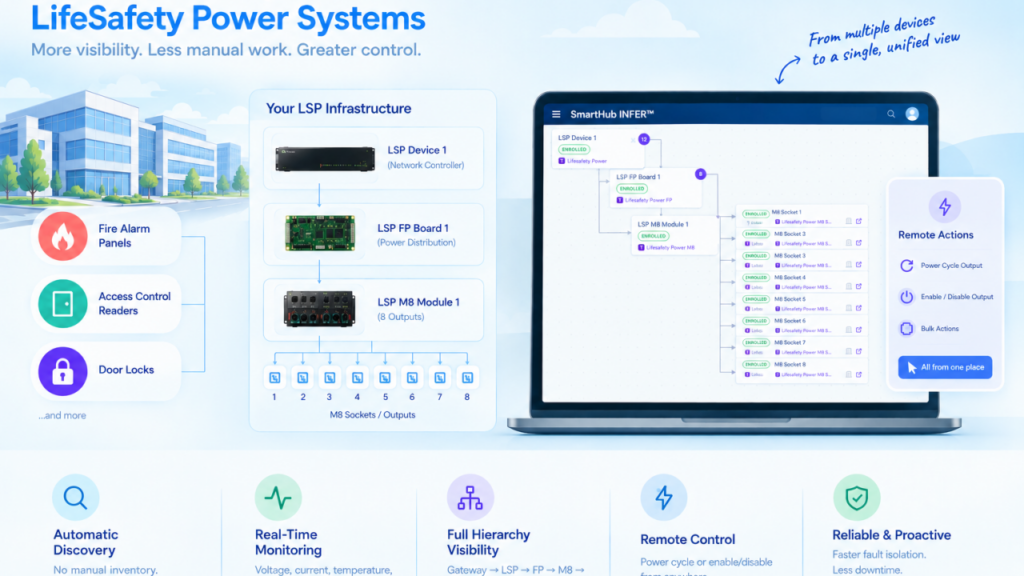
If you’ve ever worked in a large facility — a hospital, campus, data center, or airport — you know how critical LifeSafety Power Systems (LSP) are. They keep components like fire alarm panels, access control readers, and door locks operational where reliable power matters most. But managing them at scale? That’s a different story entirely.
The Problem With Managing LSP Systems Manually
Picture this: your facility has dozens of LSP network controllers spread across multiple buildings or floors. Each controller manages a set of connected Flex Power (FP) boards, which in turn regulate power to M8 distribution modules and each M8 module has up to eight individually powered outputs feeding real devices like door locks and fire alarm components.
That’s a lot of layers, and it creates a few recurring problems for the teams responsible for keeping them running:
- Manual, Walk-the-Floor Troubleshooting: When something goes wrong, say a voltage dip, a battery fault, a fire alarm input tripping, someone has to physically walk to the LSP device, check each connected FP and M8 board individually, and cross-reference voltage and current readings by hand.
- No Single View Across the Hierarchy: With dozens of LSP controllers, each branching into multiple boards and up to eight outputs per M8 module, there’s no easy way to see the full picture. Device status lives in whatever panel or the spreadsheet someone last updated.
- Slow Fault Isolation: Even after you get to know a device has an issue, figuring out exactly which board or which of the eight outputs is the actual source of the problem takes real investigation time. Time that matters most especially in LSP systems.
- Manual Recovery Actions: Power cycling a device means physically locating and accessing it. Across dozens of controllers and hundreds of outputs, it turns routine maintenance into hours of legwork.
For a single device, this is manageable. At real scale, it becomes a full-time job and a risky one, since delays or missed faults on LSP systems have real consequences. Managing LSP infrastructure at scale requires more than basic status checks. It demands a layer that unifies discovery, health monitoring, and remote control across the entire device hierarchy. A platform like SmartHub INFER™ provides that operational layer.
How SmartHub INFER™ Sees Your Power Infrastructure
Instead of treating every LSP device as an isolated device, SmartHub INFER™ models your entire power infrastructure as a connected hierarchy, in the same way it actually exists physically:
Gateway → LSP Device (parent) → FP boards and M8 modules (children) → individual outputsOnce an LSP device is connected, SmartHub INFER™ automatically discovers every FP and M8 board attached to it, along with each of the M8’s eight individually monitored power outputs. There’s no manual inventory to maintain and no spreadsheet tracking which board lives on which controller. The hierarchy builds itself and stays current as your infrastructure changes.
What Gets Monitored – This isn’t limited to just is it online or not. SmartHub INFER™ pulls detailed, real-time metrics at every level of the hierarchy:
At the LSP controller level – network reachability and response time, internal board temperature, external temperature (when a sensor is connected), firmware version, and event/alarm status tied to configured threshold.
At the FP board level – output voltage and current, so you know exactly how much power is being delivered and whether it’s within safe operating range.
At the M8 module level – per-output voltage, current, and power for all eight outputs individually. If output 3 on a specific M8 module, three layers deep in your hierarchy, starts drawing abnormal current, you see that exact output flagged, not just “something on this device needs attention.”That level of granularity is what makes the difference between monitoring and actually knowing what’s happening across your infrastructure.
How It Deploys
SmartHub INFER™ connects directly to your LSP network controllers to pull device, board, and output-level data into a single platform, working alongside your existing FlexPower hardware rather than replacing it. Once connected, discovery and monitoring run continuously in the background, so newly added boards or modules show up automatically instead of needing to be manually added to an inventory.
Remote Action, Not Just Visibility
Monitoring is only half the equation. The other half is what happens once you know something’s wrong. Traditionally, if a device needs a power cycle, someone has to physically locate it, access it, and reset it by hand. Multiply that across dozens of controllers and hundreds of individual outputs – it can turn routine maintenance task into hours of legwork. With SmartHub INFER™, enabling or disabling specific outputs is a remote command – no site visit required. And instead of opening each device individually to cycle its outputs one by one, bulk commands let you power cycle multiple outputs across multiple devices at once, all from a single place, in seconds, from anywhere.
Why SmartHub INFER™ for LSP Management?
- Full-Hierarchy Visibility: See every LSP controller, FP board, and M8 output from a single place – not device by device
- No Manual Inventory: Devices and boards are discovered and enrolled automatically, and stay current as your infrastructure changes
- Granular Diagnostics: Fault isolation down to the individual output, not just the parent device
- Remote Recovery: Power cycle outputs without a site visit, cutting response time from hours to seconds
- Deployment Flexibility: Connects to your existing FlexPower hardware without replacing it
Why This Matters
- LifeSafety power infrastructure is not something teams want to discover is malfunctioning only when they need it. Manual, walk-the-floor monitoring doesn’t scale past a handful of devices, and it puts response time in the hands of someone who can physically get to a panel fast.
- By automatically discovering the full device hierarchy and surfacing real-time metrics down to the individual output, teams shift from reactive troubleshooting to proactive management, catching issues while they’re still minor, and resolving them without leaving their desk.
- If you’re managing LifeSafety Power Systems at any real scale, this is the kind of visibility and control that turns an operational headache into a solved problem.