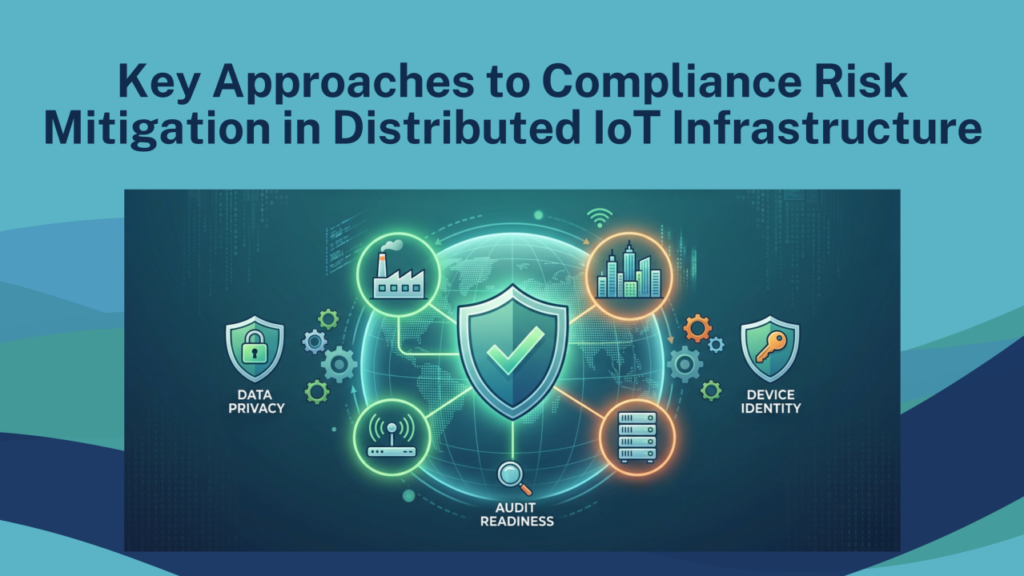
Key Approaches to Compliance Risk Mitigation in Distributed IoT Infrastructure
Fred never thought compliance would be the thing that kept him up at 2:17 a.m. He was an infrastructure engineer, not a policy person. His world was uptime, performance graphs, and making sure thousands of edge devices across factories, campuses, and remote sites stayed online. Compliance? That was “audit stuff.” Paperwork. Someone else’s problem.

Until the alert came in.

A regional audit had flagged a security control gap. One device with outdated firmware, and another with password that had not been rotated for a year! Then another. Then a cluster - all in different locations, managed by different teams. Password rotation hadn’t happened on a subset. A few devices still had insecure services enabled. Nothing dramatic on its own. But together? A compliance violation with real risk behind it. And a board-level topic!

Fred did what most engineers do under pressure - he opened five dashboards, three spreadsheets, and started calling people.

“Do we have an inventory of all devices?” “Which ones are running that firmware version?” “Who owns these site devices?”

The problem wasn’t that they didn’t care about compliance. The problem was visibility. And the time to do these tasks. The environment had grown faster than their processes. Devices were added over time, teams changed, configs drifted. Compliance wasn’t breaking in one big event - it was slowly eroding in the background.

By the time the situation was contained, Fred had a new perspective. Compliance wasn’t just about satisfying auditors. It was an early warning system for security, stability, and operational discipline. Every missed update, every expired password, every open service was a small signal - and together they told a story about risk.

What Fred really needed wasn’t more spreadsheets or more late-night calls. He needed a way to see compliance as a living, real-time picture of his environment - something that could continuously track device posture, highlight drift, and show where attention was needed before issues piled up.

That’s when compliance stopped feeling like paperwork and started looking like one of the most practical tools, he had to keep his edge environment secure, reliable, and under control.

“Fred’s experience isn’t unique. As edge environments scale, compliance gaps don’t explode, they quietly accumulate. That’s why organizations are moving toward continuous, real-time compliance visibility.”

In this blog, we’ll explore the key risks that make compliance difficult at the Edge and the practical approaches teams can use to manage and mitigate them.

Why Compliance Matters for IoT & Edge Infrastructure

Regulatory Complexity: IoT networks often cross national and regional boundaries. Regulations, industry-specific standards, and emerging frameworks (e.g., cybersecurity certification for IoT) make “one-size-fits-all” compliance nearly impossible. Further, they are all across the spectrum of “device types” like cameras/recorders or diagnostic devices and robots on the factory floor.

Risk Exposure: Each edge device is a potential entry point for attackers. From weak firmware to misconfigured connections, non-compliance can lead directly to data breaches. Something waiting to happen, anyone following CISA publications will see.
Trust & Reputation: For enterprises, compliance isn’t just about avoiding fines, it’s a signal of trust. Ensuring that devices and data pipelines are compliant increases stakeholder confidence (customers, partners, regulators) and avoids expensive downtimes.

Operational Efficiency: Regulations evolve requiring ongoing alignment and proactive compliance. Manual audits and patchwork compliance are slow and error prone. Automating compliance helps reduce cost, improve reliability, and scale as your IoT footprint grows.

“Distributed IoT networks are notoriously complex, and enforcing compliance across a huge, geographically dispersed fleet of devices is challenging.”

How Compliance Automation Drives Secure Operations

Compliance automation is not just about meeting regulatory mandates. It’s about embedding compliance deeply into the security posture of your distributed network. It’s about strengthening the overall security posture of distributed IoT environments by ensuring that policies are consistently applied, monitored, and enforced at scale. Thus far, IT had a term for it – ITSecOps; it is the same discipline that is needed for the complex new world of these distributed set of connected devices - IoTSecOps.

Continuous Monitoring & Policy Enforcement: Real-time visibility into device behaviour, network traffic, and configurations ensures deviations are instantly detected, triggering automated checks or corrective actions.

Automated Identity & Access Management: Centralized control of device identities, onboarding workflows, and access permissions ensures that only verified and trusted devices join the network, aligning with zero-trust security principles.

Dynamic Incident Response: Automated workflows can detect anomalies, classify risks, and initiate remediation steps.

Audit Trails & Evidence Collection: Logs capture device states, configuration changes, policy actions, and security events, simplifying internal audits and external compliance reporting.

Firmware & Configuration Governance: Automated OTA firmware updates and configuration drift correction help maintain strong security hygiene across distributed fleets.

Compliance Across Regulations and Frameworks

Policy-driven compliance aligned with industry regulations and standards, deliver consistent governance across diverse devices.

“Enterprise IoT compliance” represents a critical convergence of cybersecurity requirements, operational technology management, and industry-specific regulations.
Top 4 Best Practices: Operationalizing Compliance (The Discipline of #IoTSecOps)
Device Discovery & Inventory: Start by establishing a complete inventory of your IoT estate. Automated discovery capabilities can help identify devices across the environment and compile a centralized, up-to-date device inventory without manual effort.

“82% of enterprises cannot identify all of their IoT/OT devices on their network, out of which a vast majority mention that they have anxiety due to lack of visibility.”

Define Clear Security Policies: Define policies for authentication, encryption, firmware updates, certificate management, and access control. Apply zero-trust principles to device identity and access.

Regular Audits & Compliance Reviews: Run frequent compliance audits to ensure policy drift is quickly identified and corrected. An insights dashboard helps by providing real-time visibility into compliance posture, highlighting deviations, tracking trends, and enabling teams to take timely, data-driven corrective actions.

Automated Remediation: Automated remediation workflows help enforce policy baselines, push secure configurations, and correct drift before it becomes a security or audit issue.

Conclusion

Edge and distributed IoT networks are powerful enablers of digital transformation, but they also introduce significant compliance risk. For organizations aiming to scale securely, manual compliance processes are no longer enough. A modern compliance automation approach is essential to manage the complexity, enabling real-time monitoring, consistent policy enforcement, rapid incident response, and reliable auditing across diverse and distributed IoT environments.

IoTSecOps is the new emerging discipline of making sure that all your devices at the far edge are compliant and managed in a disciplined fashion. By embedding compliance (and IoTSecOps) directly into edge operations, organizations can not only meet regulatory requirements but also strengthen trust, reduce operational risk, and maintain agility as their IoT footprint continues to grow.

Looking to strengthen compliance across your Edge environment? Let’s start the conversation.

Reach out at [email protected].
🍪 We use cookies
We use cookies to enhance your experience and analyze site usage. Essential cookies are always enabled to ensure the website works properly.
Functional
Always active
The technical storage or access is strictly necessary for the legitimate purpose of enabling the use of a specific service explicitly requested by the subscriber or user, or for the sole purpose of carrying out the transmission of a communication over an electronic communications network.
Preferences
The technical storage or access is necessary for the legitimate purpose of storing preferences that are not requested by the subscriber or user.
Statistics
The technical storage or access that is used exclusively for statistical purposes.The technical storage or access that is used exclusively for anonymous statistical purposes. Without a subpoena, voluntary compliance on the part of your Internet Service Provider, or additional records from a third party, information stored or retrieved for this purpose alone cannot usually be used to identify you.
Marketing
The technical storage or access is required to create user profiles to send advertising, or to track the user on a website or across several websites for similar marketing purposes.